Adjustable DumbbellsGuide6 min
Beginner Strength Training on a GLP-1: Where to Start
TL;DR
LeanFed may earn a commission from links on this page; it never changes a ranking. Full disclosure.
The short answer
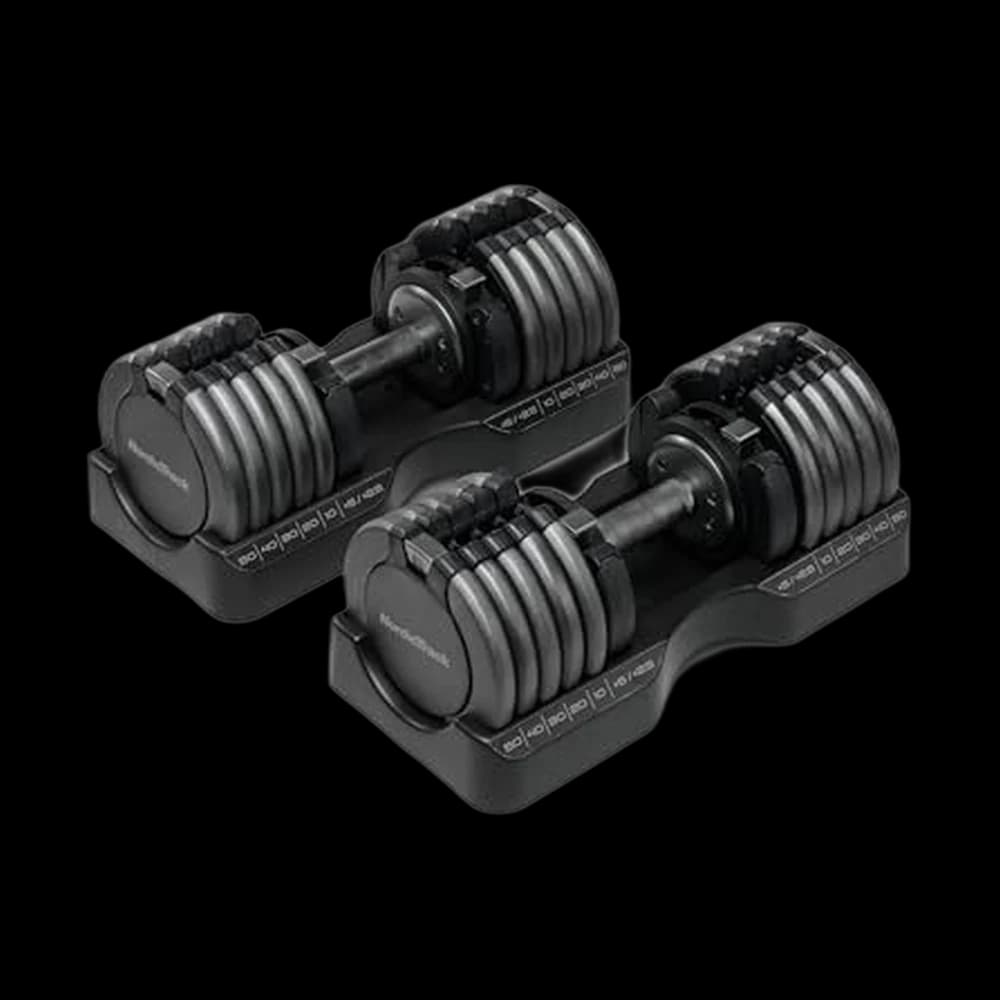
Our pick
NordicTrack 55 lb Select-a-Weight Dumbbell Pair- The most top-end weight per dollar, with trays so they are not on your floor.
- You need 2.5 lb jumps at the very bottom of the range.
Two sessions a week, four movements, and an honest answer on whether to start with resistance bands or an adjustable dumbbell.
Key takeaways
- The federal guideline is muscle-strengthening activity on 2 or more days a week, working all major muscle groups. Two sessions, not five.
- NIA describes a beginner structure as one set of 8 to 12 repetitions at moderate effort or greater, never the same muscle group two days running, and bodyweight or bands until the movements feel comfortable.
- Clear the plan with your clinician first — especially if you have heart, joint, back or blood-pressure considerations.
- The bottom of the weight range matters more than the top. A set starting at 15 lb removes most beginner shoulder work; a 5 lb start does not.
- Bands are the cheapest way to find out whether you will train at all. Dumbbells are what you move to when progression stops being guesswork.
Pick by your situation
| If your situation is… | Pick | Why |
|---|---|---|
| You are not yet sure you will train regularly | Fit Simplify loop band set | The cheapest possible way to find out, and CDC counts band work toward the muscle-strengthening recommendation. |
| Small apartment, no room for a rack | BYZOOM Classic 50 lb single | One dumbbell and no rack: it shortens as you strip weight and sits on a 12-sided base that will not roll across the floor. |
| You want small jumps and a place to put them | NordicTrack Select-a-Weight | 2.5, 5 and 10 lb increments and fitted storage trays, so the pair is not living on your floor. |
| The smallest possible footprint, expandable later | PowerBlock Elite EXP | Square block shape and a range that expands rather than being replaced. |
| You want handles, ankle straps and a door anchor in one bag | WHATAFIT resistance band set | Numbered tubes plus every accessory, and it packs into a carry-on. |
Each pick is one of the products compared below — a shortcut by situation, not a separate recommendation.
Adjustable Dumbbells: our picks
| Pick | Best for | Rating | Price | LeanScore | Buy |
|---|---|---|---|---|---|
| №1NordicTrack 55 lb Select-a-Weight Dumbbell Pair | Good top end for the money, with a real stand. | ★ 4.5 | $399.00 | 72 | Buy on Amazon |
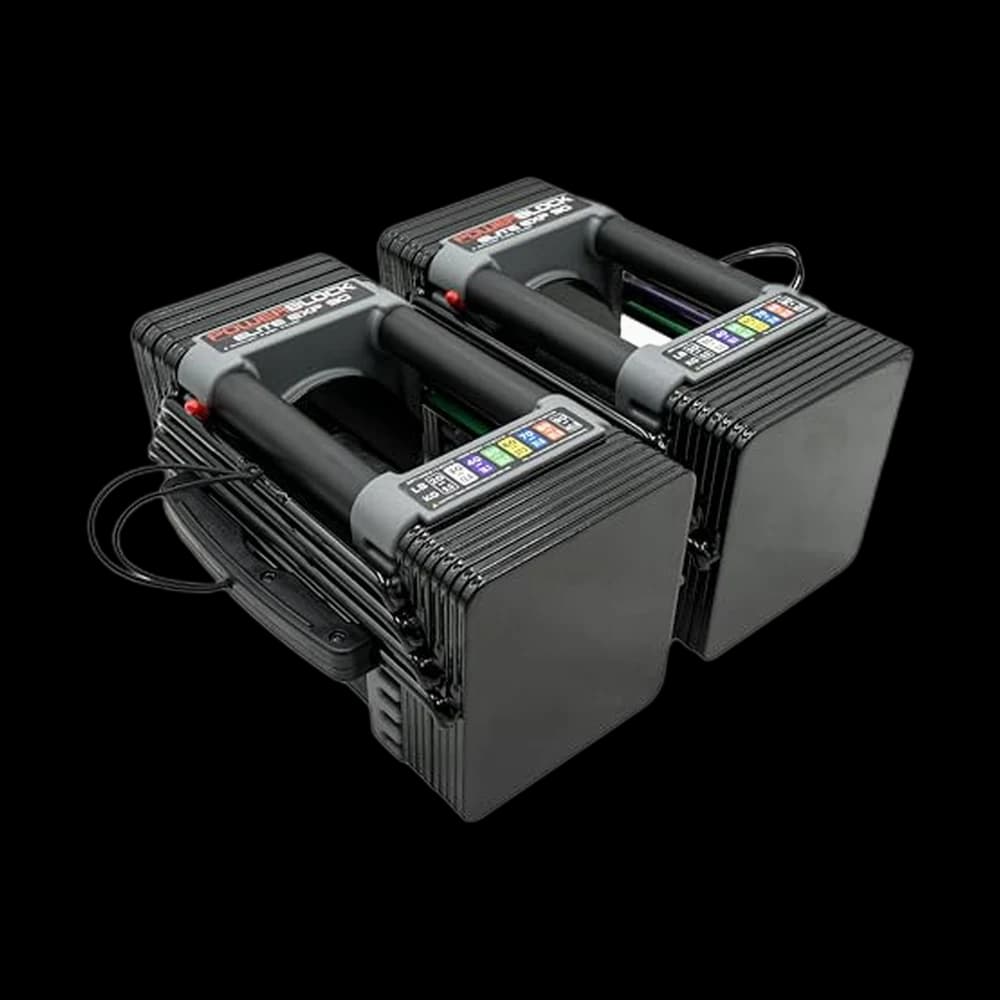 PowerBlock Elite EXP Adjustable Dumbbells, Sold in Pairs, Stage 1,… PowerBlock Elite EXP Adjustable Dumbbells, Sold in Pairs, Stage 1,… | Squarest footprint on the market and expandable later. | ★ 4.8 | $399.99 | 84 | Buy on Amazon |
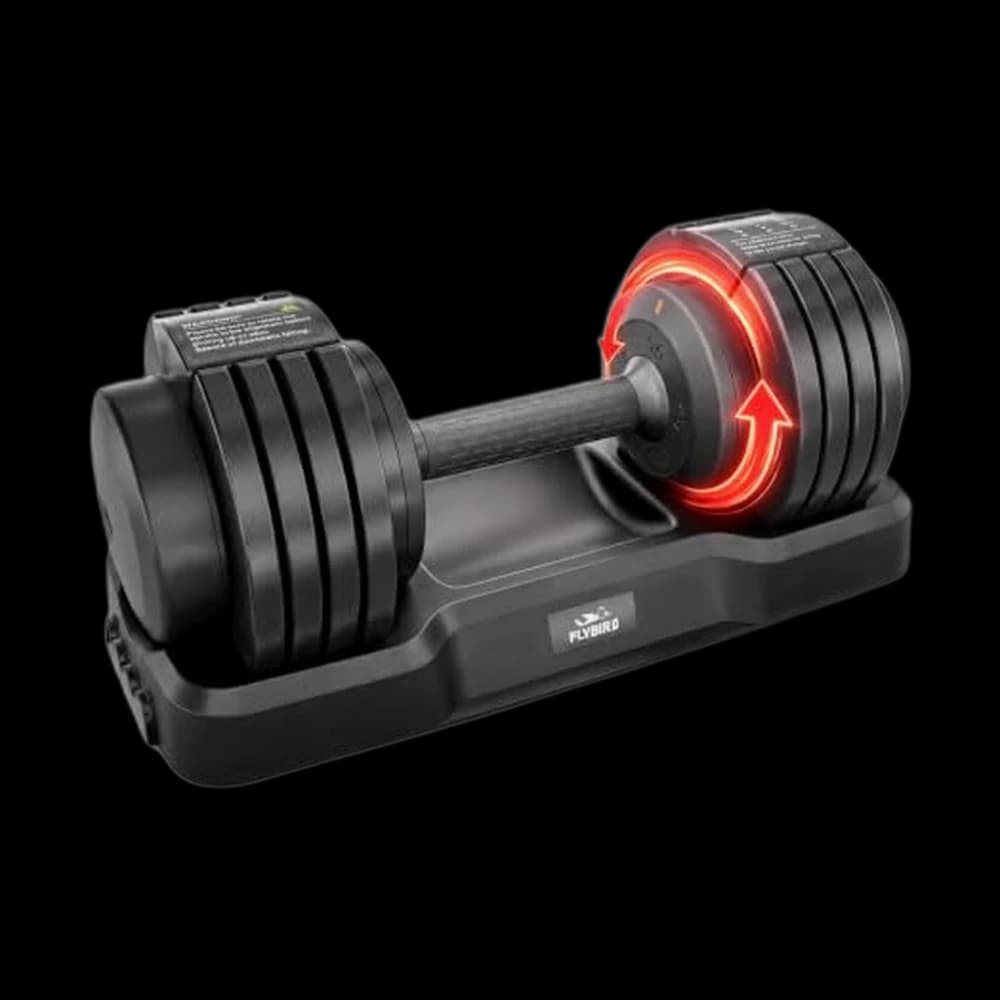 FLYBIRD DB2 Adjustable Dumbbell, 55LB Single, 5-in-1 Quick… FLYBIRD DB2 Adjustable Dumbbell, 55LB Single, 5-in-1 Quick… | One dial takes a single dumbbell from 5 to 55 lb, which is most of a beginner's first year. | ★ 4.5 | $159.99 | 75 | Buy on Amazon |
Losing weight quickly is not only a fat story. A 2026 narrative review in Nutrients on nutrition support during and dual therapy names fat-free mass loss — the muscle side of the ledger — as one of the things that limits how well these medications work in real life, and it puts resistance-training support inside its practical framework alongside protein and symptom management. Strength work is the part of that you control directly.
This guide covers what a beginner structure actually looks like, whether to start with bands or dumbbells, and which sets in our catalogue suit which situation.
Worth raising at your next visitFrom this guide
Before anything else: get your prescriber's or a physical therapist's clearance before you start , especially if you have heart, joint, back or blood-pressure considerations. Dizziness, chest pain, unusual shortness of breath or fainting during exercise is a stop-and-call, not a push-through.
The picks at a glance
Every set below is in our adjustable dumbbells catalogue. Specifications are the manufacturer's own; we research and compare from specifications, labels and owner reviews rather than lifting anything ourselves.
| Set | Range per hand | Increment | Sold as | Adjustment |
|---|---|---|---|---|
| NordicTrack Select-a-Weight | Up to 55 lb | 2.5, 5 and 10 lb | Pair | Weight selector |
| PowerBlock Elite EXP | 5–50 lb | 2.5 lb adder, then 5 lb steps | Pair | Magnetic pin |
| FLYBIRD DB2 | 15–55 lb (5 settings) | 10 lb steps | Single | Quick 5-in-1 select |
The column that decides most first purchases is not the top of the range. It is the bottom. A set that starts at 15 lb takes lateral raises, rotator work and most single-arm shoulder movements off the table in week one, and week one is when you need the easy version.
What do general adult strength guidelines say?
Less than people assume. The federal Physical Activity Guidelines for Americans put it in one sentence: adults should do muscle-strengthening activities of moderate or greater intensity involving all major muscle groups on 2 or more days a week. CDC repeats the same figure in plain language, alongside the 150-minutes-a-week aerobic target.
The guideline describes weekly frequency and muscle groups, not a fixed session length or a personalized GLP-1 exercise plan.
A common beginner structure
The National Institute on Aging describes the shape most beginner programmes take, and it is worth reading as the starting template rather than something clever:
- At least two days a week, working the major muscle groups — legs, hips, chest, back, abdomen, shoulders and arms.
- Avoid working the same muscle group on two days in a row, so the muscle gets recovery between sessions.
- Moderate effort or greater — heavy enough that another repetition would be difficult.
- One set of eight to twelve repetitions is effective, though two or three sets may be more so.
- If you are new to it, try the movements without weights or resistance bands until they feel comfortable; bands and dumbbells come after that.
A clinician or qualified exercise professional can help turn the guideline into movements suited to your strength, balance and mobility. This page compares equipment; it does not assess which exercises or session length are safe for you.
Rule of thumb: treat the two sessions as the fixed points in your week and let everything else move around them. Two mediocre sessions beat one perfect one followed by three weeks off.
Clear the structure with your clinician before you run it, particularly the intensity part.
Bands or dumbbells first
Both answers are defensible, and the honest version is that it depends on what would stop you.
What people in these communities keep saying: across r/Mounjaro, r/Zepbound and r/WegovyWeightLoss, muscle loss is one of the most-discussed non-digestive worries, and the advice inside those threads converges on starting resistance work earlier in the process rather than waiting for the weight to come off. A vocal group argues, credibly, that bodyweight work and bands are plenty for a beginner and cost almost nothing — that is offered as a real alternative, not a consolation prize. The barrier people actually report is fatigue in the day or two after an injection, and the workaround they describe is scheduling training away from it rather than pushing through.
Adjustable dumbbells get named specifically for space: a whole rack's worth of loading in the footprint of a shoebox, which is what makes a twenty-minute session realistic on an evening you were never going to leave the house.
Where bands win
- Cheapest possible way to find out whether you will use any of this.
- No floor space, and they travel — which matters if sessions happen whenever they can.
- The THERABAND beginner kit is the flat clinic band a physical therapist hands you, labelled in genuinely light resistance.
- A tube set with handles and a door anchor covers most pushing and pulling movements.
Where dumbbells win
- Progression is a number, not a feel. Band resistance changes with how far you stretch it, so printed pound ratings are approximations by definition and are not comparable across brands.
- You will outgrow a band set faster than you expect. Several people describe exactly that within a few months.
- Loading a squat or hinge with bands is awkward; loading it with a dumbbell is obvious.
Decision shortcuts
| If this is you | Start with | Because |
|---|---|---|
| Not sure you will stick with it | A loop band set | The cost of finding out is trivial |
| Small apartment, no dedicated space | One adjustable dumbbell | A single unit does most beginner movements one arm at a time |
| Joint or mobility considerations | Bands, cleared with a physio | Light, controlled resistance with no drop risk |
| You already know you will keep going | A pair with small increments | The bottom of the range and the increment size are what you live with |
The mistakes that cost the most
What actually helps:
- Buying for the bottom of the range and the change speed.
- Keeping sessions short enough that you will do the second one.
- Eating to the protein target your clinician set for you, on training days and the others.
- Measuring progress as "that was heavier than last month", not as a number on a scale.
What people do instead:
- Paying for eighty pounds a hand they will not touch this year.
- Choosing a slow adjustment mechanism, then quietly stopping because changing weight between exercises breaks the rhythm.
- Training hard and eating almost nothing, which is doing half the job.
- Starting with a heroic first week.
Where this fits in the Path
Strength is the centrepiece of Stage 3: Building, but nothing stops you starting earlier — the community advice is explicitly to start sooner than feels necessary. Pair it with the eating side in protein-first eating on a GLP-1, and if you are travelling, bands are the only strength equipment that fits in a carry-on.
Your next step
Pair the plan your clinician set with a protein option you can reliably finish.
Frequently asked
The questions that keep coming up
How many days a week should I lift?
The Physical Activity Guidelines for Americans advise muscle-strengthening activity on 2 or more days a week, involving all major muscle groups. NIA adds that you should avoid working the same muscle group on two consecutive days so it can recover. Two sessions a week is the target, not a minimum you should feel bad about.
Do I need dumbbells, or are resistance bands enough to start?
CDC counts resistance band work and bodyweight exercise toward the muscle-strengthening recommendation alongside weights, and NIA lists resistance bands among its muscle-strengthening options, while suggesting complete beginners first try the movements without weights or bands until they feel comfortable. Bands are a legitimate first purchase. People commonly move to dumbbells later, when band resistance stops being enough and the lack of a real number makes progression hard to track.
How much protein should I be eating if I am lifting?
There is no universal number, and we do not publish one. Ask your clinician for the target they want you on, and note that kidney involvement in particular changes the answer. Eat to the target your clinician set, on training days and on the others.
I am exhausted for a day or two after my injection. Should I train through it?
People in the GLP-1 subreddits describe scheduling training away from the day or two following a shot rather than pushing through it, and that is a reasonable pattern to try. Persistent or severe fatigue is a conversation with your prescriber, not something to plan around indefinitely.
Will lifting stop me losing muscle while I lose weight?
No product or programme can promise that. What we can say is what the sources say: the 2026 Nutrients review of nutrition support during incretin therapy includes resistance-training support in its practical framework, and NIA describes muscle-strengthening exercise as key to maintaining existing strength and slowing the loss of muscle mass. Paired with the protein target your clinician set, it is the part of the response you control.
Sources & further reading
We research from primary and authoritative sources. Where our guidance rests on a fact, here's where it comes from.
- Physical Activity Guidelines for Americans, 2nd edition (ODPHP) — Page 8: adults should do muscle-strengthening activities of moderate or greater intensity involving all major muscle groups on 2 or more days a week.
- CDC — Adult Activity: An Overview — The same guidance in plain language: 150 minutes of moderate-intensity activity a week plus at least 2 days of muscle-strengthening activity.
- National Institute on Aging — Three Types of Exercise Can Improve Your Health and Physical Ability — Source of the beginner structure: two days a week, major muscle groups, no same group on consecutive days, one set of eight to twelve repetitions, bands or bodyweight to begin. Also the statement that this exercise is key to maintaining existing strength and slowing the loss of muscle mass.
- Zambrano-Villacres et al., Nutrition-First Support for GLP-1 and Dual Incretin Therapy in Obesity, Nutrients (2026), PMC13258902 — Open-access review. Its abstract names fat-free mass loss as a limit on real-world effectiveness and places resistance-training support inside the practical framework alongside protein and symptom management.
LeanFed is not medical advice and is not a substitute for your prescriber, pharmacist or dietitian. We do not test products hands-on — we compare labels, specifications and owner reviews. Prices and LeanScores reflect our most recent research and refresh on a cycle; confirm the current price and read the product's own label before buying. We may earn a commission from affiliate retailers — it never changes our recommendations. See how we score.