Guide6 min
Eating Out on GLP-1: What the Menu Has to Tell You
TL;DR
Chain restaurants must hand over protein numbers on request. Here is how to use that, what the rule exempts, and how to box leftovers safely.
Key takeaways
- Chains with 20 or more locations must give you written nutrition information, protein included, if you ask.
- Daily specials, temporary items, custom orders and independent restaurants sit outside that rule.
- Posted numbers need only a reasonable basis, so treat the protein line as a ballpark for comparing dishes.
- Box leftovers when the food arrives: FSIS counts the two-hour refrigeration window from cooking, not from when you get home.
Pick by your situation
| If your situation is… | Pick | Why |
|---|---|---|
| A chain with calories on the menu board | Ask for the written nutrition sheet | Chains with 20 or more locations must provide protein, sodium and the other listed nutrients on request, and the menu must say so. |
| An independent restaurant | Order by format, not by numbers | Non-chain restaurants are outside the federal menu rule, and a 2016 study measured their meals as large as chain meals. |
| You already know you will take half home | Ask for the box when the food arrives | FSIS counts the two-hour refrigeration window from cooking, so table time is already on the clock. |
| A daily special or a dish you have customised | Treat any posted number as unknown | Daily specials, temporary items and custom orders are exempt from the labeling rule. |
| A long dinner where the food is the event | Order a starter or lunch portion as your main | A smaller plate lets you eat at the table's pace without a full entree waiting to be boxed. |
A shortcut by situation, not personal advice — your care team's plan comes first.
The plate that lands in front of you was sized for someone else's appetite. When researchers bought the most frequently ordered meals from independent restaurants in three US cities and measured them in a lab, the meals averaged about 1,205 calories, and 92% exceeded typical energy requirements for a single eating occasion. That is not a reason to eat less than you want. It is a reason to stop treating a half-finished plate as a problem, and to plan for it before you order.
Before you go: if your care team has set food, fluid or alcohol limits, those come first. Severe stomach pain that will not go away, with or without vomiting, is a reason to call your healthcare provider right away, as is vomiting or diarrhea that leaves you unable to keep fluids down. A menu strategy is not the fix for either.
The menu is required to tell you more than it shows
Most diners never ask for the one thing a large chain has to hand over. Under FDA's menu labeling rule, in force since May 7, 2018, restaurants that are part of a chain with 20 or more locations must post calories, and must also provide written nutrition information on request, protein included.
| On the menu board | In writing, if you ask |
|---|---|
| Calories per standard item | Total calories, total fat, saturated fat, trans fat |
| A note that more information is available | Cholesterol, sodium, total carbohydrates |
| A 2,000-calorie general-advice statement | Sugars, fiber and protein |
The regulation even fixes the wording: every covered menu has to carry the line "Additional nutrition information available upon request." If you eat protein first, that sheet is the useful document in the building. A dish can be modest in calories and still carry most of its volume as sides.
Where the rule stops
The same regulation lists what is exempt. Knowing the gaps is what keeps you from trusting a number that does not apply.
- Independent restaurants. About half of US restaurants are individual or small-chain places that do not provide nutrition information, and the same study found their meals no smaller than chain meals.
- Daily specials. Items promoted for a particular day are outside the labeling requirement.
- Temporary items. Anything on the menu for fewer than 60 days in a calendar year.
- Custom orders. The rule's own example is a club sandwich without the bacon. Once you change a dish, its posted numbers no longer describe your plate.
- Condiments on the table. Sauces and toppings for general use are exempt too.
The protein line is a reasonable estimate, not a lab result
A covered restaurant must have a "reasonable basis" for its numbers, and the regulation accepts nutrient databases, cookbooks, laboratory analysis or packaged-food labels. A recipe calculation is allowed. A cook's heavy hand is not on the sheet.
What one audit found: a 2011 JAMA study measured 269 restaurant items with bomb calorimetry. Overall, stated calories were close to measured, off by about 10 per portion. But 19% of items held at least 100 calories more than stated, and items listed as lower in calories tended to run higher than listed.
That study measured energy, not protein. The closest protein check we found is smaller: a 2015 exploratory study of 150 samples from campus dining outlets, analysed with nutrient software rather than a lab, found protein and portion weight both differed from the published claims, with protein averaging more than 10% above what was listed. So read the protein figure as a ballpark for comparing two dishes on one menu, not a number to log to the gram.
Order for the appetite you have today
Ordering well on a small appetite is mostly a script problem. Here is what the usual moment sounds like, and what to say instead.
- "I'll just have the entrée." → Ask whether a starter, a side-size portion or a lunch portion can be your main. Asking costs nothing.
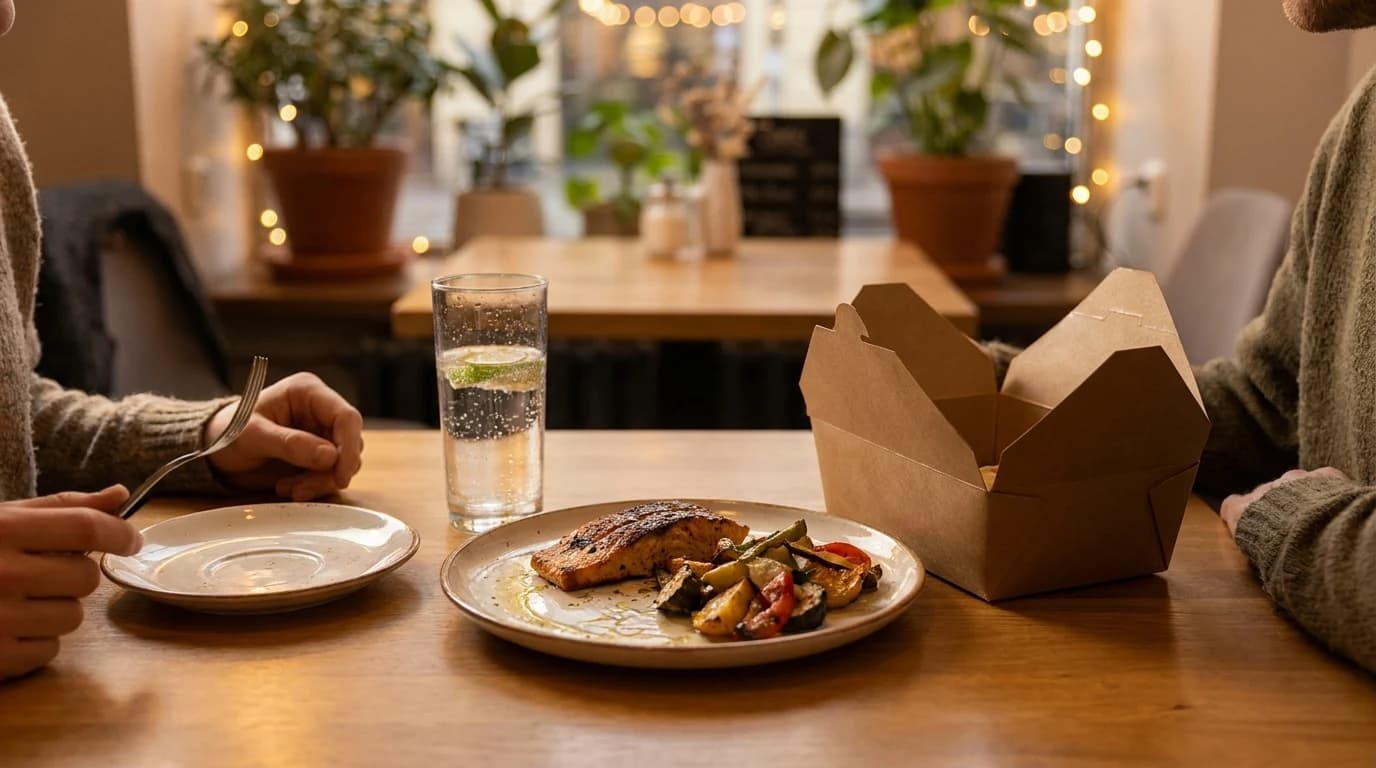
- "I'll box what's left later." → Ask for the box when the food arrives, and move half into it before you start.
- "Everyone's sharing plates." → Take one small serving of the protein dish first, then decide whether you want more.
- "The kids' menu looks right." → Some restaurants reserve it for children, so ask rather than assume.
- "I'm full, but it's rude to stop." → "It was great, I'm just done. Could I get a box?" is a complete sentence.
If one kind of dish has made you uncomfortable before, that is your best predictor. The prescribing labels we cite do not publish a list of restaurant foods to avoid, and neither do we.
The two-hour clock starts in the kitchen
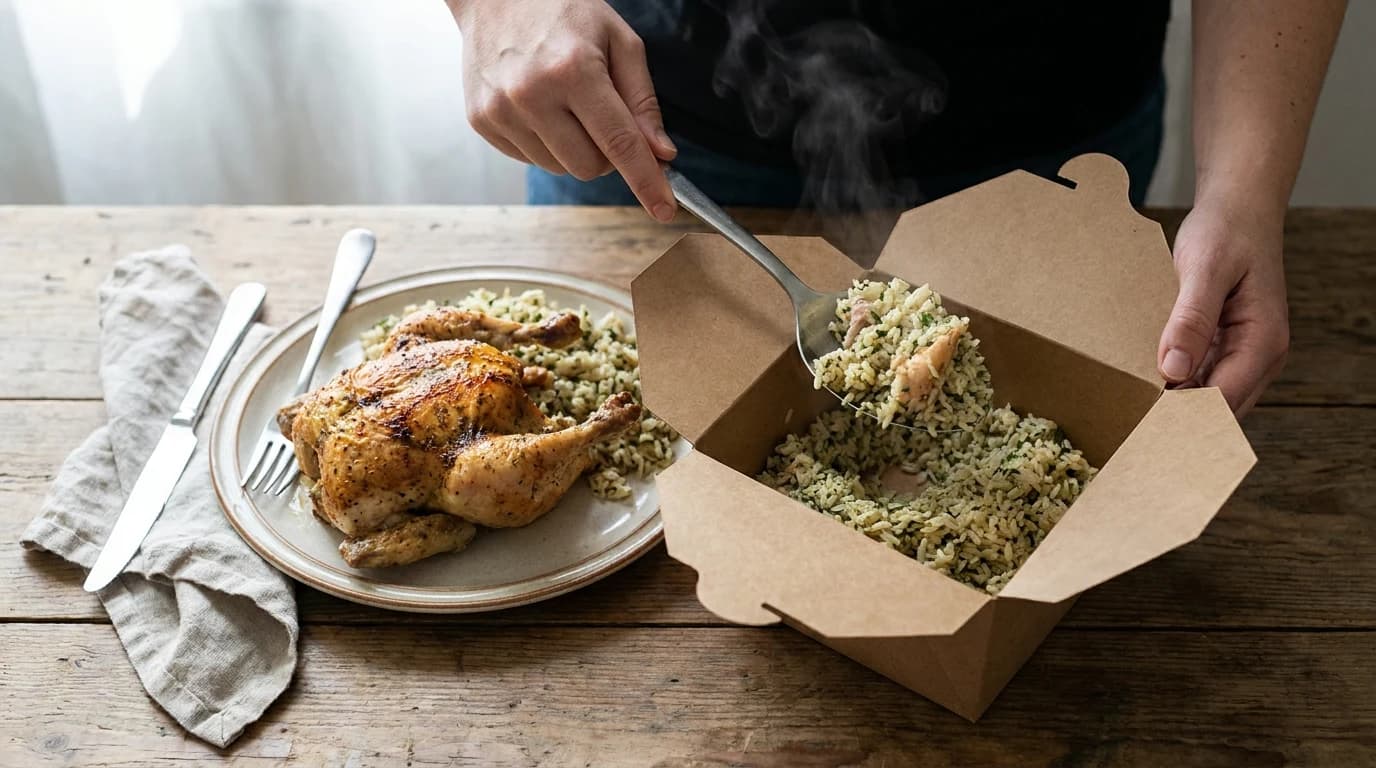
Leftovers are where a restaurant meal on a small appetite earns its price, and where the timing gets misread. USDA's Food Safety and Inspection Service says leftovers must be refrigerated within 2 hours of cooking, or 1 hour above 90°F. The clock starts when the food is cooked, not when you get home, so a long dinner can spend most of it at the table.
- Box the portion you will not eat when the plate arrives.
- Keep the drive home short, and skip the warm car on a hot day.
- Refrigerate on arrival, and split anything deep into shallow containers so it cools fast.
- Eat it within 3 to 4 days, or freeze it; FSIS gives 3 to 4 months frozen for best quality.
A set of small containers turns one restaurant entrée into two or three home meals. Our 4-to-8-ounce container guide covers the sizes that match a small appetite.
Who decides what you order
You do, with your care team's plan behind you. Nothing about eating out on a requires finishing a plate, skipping one or explaining yourself. If eating enough has become hard rather than just smaller, that is worth raising with your prescriber or a dietitian; our appointment worksheet helps you bring the right notes.
Your next step
Where most people go from here
Frequently asked
The questions that keep coming up
Can I ask a restaurant for the protein content of a dish?
At a chain with 20 or more locations, yes. FDA's menu labeling rule requires covered restaurants to provide written nutrition information on request, and protein is one of the listed nutrients. Independent restaurants are not covered, so they may have no numbers to give.
Are restaurant nutrition numbers accurate?
They are estimates. The regulation requires a reasonable basis, which can be a nutrient database or recipe calculation rather than a lab test. A 2011 JAMA study found stated calories close to measured overall, but 19% of items held at least 100 calories more than stated.
How long can restaurant leftovers sit out?
USDA's Food Safety and Inspection Service says to refrigerate leftovers within 2 hours of cooking, or 1 hour above 90°F, then eat them within 3 to 4 days or freeze them. The time at the table counts toward those 2 hours.
Is it rude to leave most of a restaurant meal?
No. Asking for a box at the start of the meal is ordinary, and a restaurant portion is sized for a typical appetite. If eating enough has become difficult rather than just smaller, raise it with your prescriber or a dietitian.
Sources & further reading
We research from primary and authoritative sources. Where our guidance rests on a fact, here's where it comes from.
- FDA — Menu Labeling Requirements — Chains with 20 or more locations post calories and provide written nutrition information, including protein, on request; compliance date May 7, 2018.
- eCFR — 21 CFR 101.11, Nutrition labeling of standard menu items — Required 'available upon request' statement, the reasonable-basis standard, and the exemptions for daily specials, temporary items, custom orders and table condiments.
- Urban et al., JAND 2016 — Energy contents of frequently ordered restaurant meals — Non-chain meals averaged 1,205 kcal, no different from chain meals; 92% exceeded typical requirements for one eating occasion; about half of US restaurants provide no nutrition information.
- Urban et al., JAMA 2011 — Accuracy of stated energy contents of restaurant foods — 269 items by bomb calorimetry: accurate overall, but 19% held at least 100 kcal more than stated.
- Menu label accuracy at a university's foodservices, Appetite 2015 — Exploratory analysis of 150 campus foodservice samples; protein and portion weight differed significantly from published claims.
- USDA FSIS — Leftovers and Food Safety — Refrigerate within 2 hours of cooking (1 hour above 90°F); 3 to 4 days refrigerated, 3 to 4 months frozen; shallow containers.
- DailyMed — Mounjaro prescribing information and Medication Guide — Call your healthcare provider right away for severe stomach pain that will not go away; vomiting and diarrhea can cause dehydration.
LeanFed is not medical advice and is not a substitute for your prescriber, pharmacist or dietitian. We do not test products hands-on — we compare labels, specifications and owner reviews. Prices and LeanScores reflect our most recent research and refresh on a cycle; confirm the current price and read the product's own label before buying. We may earn a commission from affiliate retailers — it never changes our recommendations. See how we score.