Guide6 min
GLP-1 Patches: What's in Them and What Skin Absorbs
TL;DR
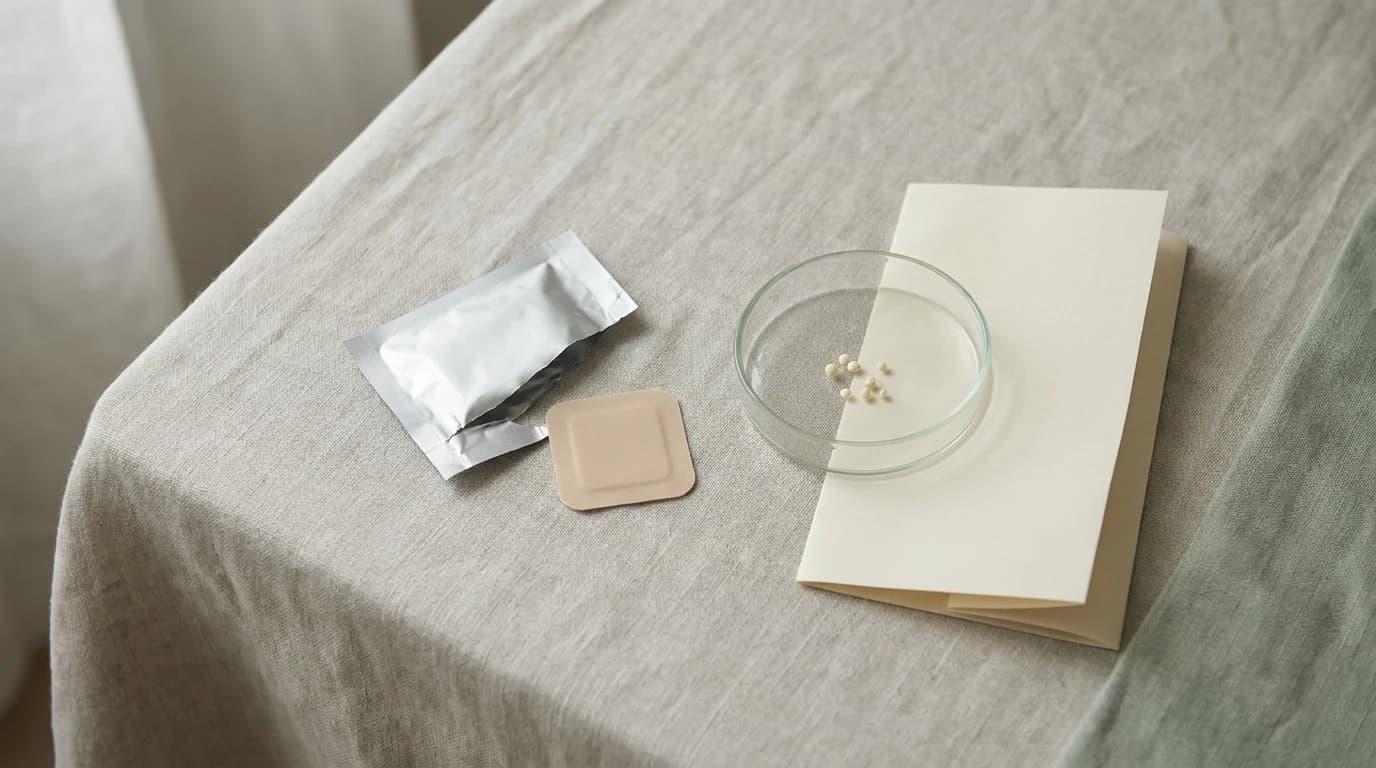
Semaglutide weighs 4,113.58 g/mol. Skin stops around 500. Here is what these patches actually list, and what FDA's own definition says about them.
Key takeaways
- Intact skin has a working ceiling of about 500 daltons. Bos and Meinardi argued in Experimental Dermatology that a compound must be under 500 Da to be absorbed, and that every drug then used in a transdermal system was under it.
- Semaglutide is 4,113.58 g/mol and tirzepatide is 4,813.53 Da, straight off the Ozempic and Zepbound labels — eight to ten times over that ceiling. That is why both are injections.
- A 2026 Annals of Pharmacotherapy review found 24 patch products and one gel, averaging seven botanical ingredients each: berberine, glutamine or glutamate, cinnamon and pomegranate led the lists.
- FDA's definition excludes the format entirely. A dietary supplement is a product that is ingested — specifically, swallowed — so topical products are not supplements, whatever the packaging says.
- The ingredient evidence is oral, and mostly gram-level. NCCIH puts berberine's weight signal at more than a gram a day by mouth, in studies it calls inconclusive. No listing we read publishes an amount per patch.
Pick by your situation
| If your situation is… | Pick | Why |
|---|---|---|
| You saw a patch on TikTok and want to know whether it is the drug | It is not, and no seller claims it is | The peptides weigh 4,113 and 4,814 daltons against a skin-absorption ceiling near 500. The patches list plant extracts. |
| You cannot get or cannot afford prescribed therapy | Your prescriber or pharmacist, not a patch | FDA has a standing warning page about unapproved and counterfeit versions of these drugs. None of that risk gets smaller by buying a patch instead. |
| You are already on a prescribed GLP-1 and saw a patch sold as support | Tell your clinician what you are wearing | Berberine is documented to interact with at least one prescription medicine, and no listing states how much of it is in the adhesive. |
| You want to judge a specific product on its own terms | Ask the seller for a certificate of analysis | The Annals review found none of the 25 products posted one, and many were missing the FDA disclaimer as well. |
| You want to spend the money on something that holds up | Protein and resistance training | Both are covered in our guides, both are free to start, and neither rests on a claim anyone would have to defend. |
Each pick is one of the products compared below — a shortcut by situation, not a separate recommendation.
A patch is a delivery system, and delivery systems have physical limits. That settles most of this before you reach the question of whether the ingredients do anything.
The number that decides it
Dermatology has a working ceiling for what intact skin will let through. Bos and Meinardi set it out in Experimental Dermatology in 2000: a compound has to be under 500 daltons to cross the corneal layer. Their supporting argument is the one that matters here — every drug then in use in a transdermal delivery system was under 500 Da.
is a modified 31-amino-acid peptide. The Ozempic prescribing information gives its molecular weight as 4,113.58 g/mol; the Zepbound label puts at 4,813.53 Da. Not near the ceiling — eight to ten times over it, which is why both are injections. Put the approved patches beside them:
| Drug | How it is delivered | Molecular weight |
|---|---|---|
| Estradiol | Transdermal patch | 272.39 g/mol |
| Scopolamine | Transdermal patch | 303.35 |
| Buprenorphine | Transdermal patch | 467.6 |
| Semaglutide | Subcutaneous injection | 4,113.58 g/mol |
| Tirzepatide | Subcutaneous injection | 4,813.53 Da |
Buprenorphine is the row worth staring at. At 467.6 it sits just under the line, and it is about as heavy as an approved transdermal drug gets.
Transdermal delivery is not a technology waiting for the right molecule to come along. It is a physical filter, and a peptide is on the wrong side of it.
What the products actually list
None of it is concealed, which is the strange part. A 2026 review in the Annals of Pharmacotherapy identified 24 transdermal patch products plus one gel, carrying an average of seven botanical ingredients each. The four listed most often: berberine, glutamine or glutamate, cinnamon and pomegranate.
We read two current seller pages to see how that reads at the point of sale. Both name much the same list — berberine, pomegranate, cinnamon, L-glutamine, chromium — and both describe a plant-extract blend rather than a peptide. Neither publishes an amount for anything:
- What the listing gives you: a set of extract names, a wear time, and a promise about how simple the routine is.
- What the listing withholds: milligrams per patch, any delivered amount, or a figure you could line up against the studies those ingredient names borrow their credibility from.
The review found the same absence at scale: no product posted a certificate of analysis, many lacked the FDA disclaimer, and many used deceptive advertising.
The legal problem printed on nobody's box
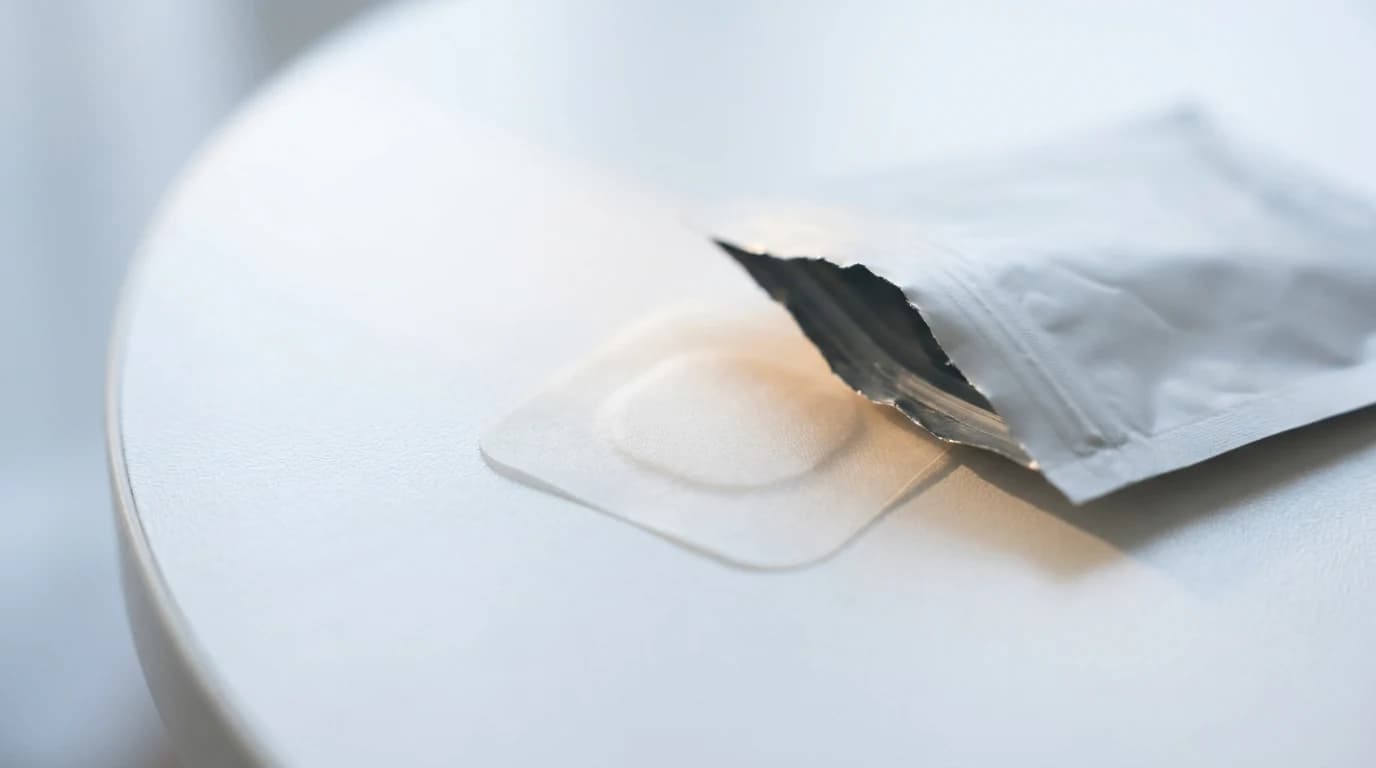
This is the part that surprised us, because it is not a matter of interpretation. FDA's own consumer page defines a dietary supplement, and the definition rules the format out in one sentence:
Dietary supplements are products that are ingested — specifically, they must be swallowed — so, for example, topical or inhaled products are not supplements.
That is on FDA's questions and answers on dietary supplements. The Annals review gets to the same place from the statute: the Dietary Supplement Health and Education Act specifies that supplement products must be swallowed, so a patch sold as one sits outside the category printed on its own packaging.
But some of these ingredients are small molecules
This is the honest counter-argument, and it deserves an answer rather than a brush-off. Berberine is not a peptide. PubChem puts it at 336.4 g/mol, under the 500-dalton line; L-glutamine is 146.14 and cinnamaldehyde 132.16. On size alone, those could cross skin.
Size is necessary and nowhere near sufficient. Three further things would have to be true, and none of them is:
- The amount has to be plausible. NCCIH's review of berberine and weight loss finds effects mainly in people taking more than one gram a day, by mouth, for more than eight weeks — and calls the evidence inconclusive, with many of the underlying studies at high risk of bias. A gram a day is not a patch-sized quantity of anything.
- The amount has to be disclosed. No listing we read gives one, and the Annals review found no certificates of analysis across all 25 products.
- The evidence has to be for this route. Every study behind these ingredient names used the swallowed form. NCCIH describes the catechins and caffeine in green tea as having a modest effect on body weight — again, swallowed, and with liver injury reported in some people who used the extract in capsule form.
Small enough to cross is the first hurdle in a race none of this has entered.
Claims versus what the label supports
| What the marketing says | What the label or the evidence actually supports |
|---|---|
| Works the way the injection does | No approved receptor agonist appears on any of these ingredient lists |
| Absorbs straight through your skin | The named ingredients carry oral evidence only; the peptides sit eight to ten times over the absorption ceiling |
| Clinically studied ingredients | Studied by mouth, largely at gram-level amounts, in reviews that call the results inconclusive |
| A gentler route than a prescription | Not the same category of product at all — FDA's definition excludes topical products from being supplements |
| Plant-based wellness support | Not a regulated claim, and no product in the review published a certificate of analysis |
Where the actual risk sits
Not in the adhesive.
Worth raising at your next visitFrom this guide
Worth saying plainly: the risk is a patch standing in for therapy you were prescribed, or delaying the conversation about why you cannot get it. Tell your prescriber and your pharmacist what you are wearing — berberine is documented to interact with at least one prescription medicine, and nothing on these labels tells anyone how much of it is on your arm.
FDA keeps a page on unapproved GLP-1 drugs used for weight loss because the demand these patches ride is the demand that also produced counterfeit Ozempic, fraudulent products naming pharmacies that do not exist, and adverse-event reports in the hundreds. The patch is the harmless-looking end of that market.
What actually moves the needle
Nobody should feel foolish for looking. This medication is expensive, frequently out of reach, and the patch is the cheapest-looking door in the building. The things that genuinely change how a course goes are unglamorous, and mostly not purchases at all:
- Protein first, at whatever meals you manage — the single intake decision that matters most once total volume drops.
- Strength training you can actually begin — two sessions a week, no gym membership required.
- Why muscle is the thing to defend — what means, and why it is the real cost of losing weight quickly.
- Fiber and fluid, ramped slowly — for the discomfort that sends most people shopping in the first place.
Every one is free to read and cheaper to act on than a monthly subscription to something the law does not accept is a supplement.
Your next step
The things that actually change a course, none of which is a patch.
Frequently asked
The questions that keep coming up
Can a patch deliver semaglutide through the skin?
No. The molecular-weight ceiling for absorption through intact skin is usually put at about 500 daltons, and semaglutide's own label gives its molecular weight as 4,113.58 g/mol. Tirzepatide is 4,813.53 Da. For comparison, buprenorphine at 467.6 is roughly as heavy as an approved transdermal drug gets. A peptide that size is not a formulation problem waiting to be solved — it is on the wrong side of a physical filter.
So what is actually in a GLP-1 patch?
Botanical extracts. A 2026 review in the Annals of Pharmacotherapy identified 24 transdermal patch products and one gel carrying an average of seven natural ingredients each, with berberine, glutamine or glutamate, cinnamon and pomegranate appearing most often. The two seller pages we read listed berberine, pomegranate, cinnamon, L-glutamine and chromium, and neither published an amount for any of them.
Berberine is a small molecule. Could that part of it work?
Size is the first hurdle, not the only one. Berberine is 336.4 g/mol, under the 500-dalton line, so crossing skin is not physically impossible for it. But NCCIH's summary of the research finds weight effects mainly in people taking more than a gram a day by mouth for over eight weeks, and describes the evidence as inconclusive with many high-risk-of-bias studies. A gram a day is not a patch-sized quantity, and no listing we read discloses what is actually in the adhesive.
Are these patches legal to sell as supplements?
FDA's consumer page is explicit that dietary supplements must be swallowed, and that topical or inhaled products are therefore not supplements. The Annals review reaches the same conclusion from the Dietary Supplement Health and Education Act and states plainly that these products violate the law. We are not lawyers and this is not legal advice — but the definitional problem is printed on FDA's own site, and it is worth knowing before you subscribe to anything.
Is there any harm in just trying one?
The adhesive is not the concern. Two things are. First, a patch standing in for prescribed therapy, or delaying the conversation about why you cannot get it. Second, an undisclosed amount of a botanical that is documented to interact with prescription medicines — berberine has been shown to interact with cyclosporine, and NCCIH also flags it as likely unsafe in infants and possibly in pregnancy. Tell your prescriber and pharmacist what you are wearing.
Sources & further reading
We research from primary and authoritative sources. Where our guidance rests on a fact, here's where it comes from.
- Bos JD, Meinardi MM — The 500 Dalton rule for the skin penetration of chemical compounds and drugs (Experimental Dermatology, 2000) — Source for the 500-dalton ceiling. The abstract argues molecular weight must be under 500 Da to allow skin absorption, and notes that all topical drugs then used in transdermal drug-delivery systems were under 500 Da. Record confirmed via the EuropePMC REST API (PMID 10839713).
- Annals of Pharmacotherapy (2026) — White CM, Tai Z, Nuzi K, on transdermal dietary-supplement patches marketed under GLP-1 branding (PMID 41480958) — Source for the 24 patch products plus one gel, the average of seven ingredients each, the four most-listed ingredients, the absence of certificates of analysis, the missing FDA disclaimers, and the DSHEA swallowing requirement. Record confirmed via the EuropePMC REST API (PMID 41480958).
- FDA — Questions and Answers on Dietary Supplements — Source for the quoted definition: dietary supplements are products that are ingested, specifically they must be swallowed, so topical or inhaled products are not supplements.
- DailyMed — OZEMPIC (semaglutide) injection, prescribing information — Description section: molecular formula C187H291N45O59, molecular weight 4,113.58 g/mol, and the 31-amino-acid backbone. Also the subcutaneous route.
- DailyMed — ZEPBOUND (tirzepatide) injection, prescribing information — Description section: molecular weight 4,813.53 Da, empirical formula C225H348N48O68, for subcutaneous use.
- DailyMed — BUTRANS (buprenorphine) transdermal system, prescribing information — Description section: molecular weight of buprenorphine 467.6, empirical formula C29H41NO4 — the heaviest drug in our comparison table and still under the 500 Da line.
- DailyMed — TRANSDERM SCOP (scopolamine) transdermal system, prescribing information — Description section: scopolamine molecular weight 303.35, empirical formula C17H21NO4.
- DailyMed — VIVELLE-DOT (estradiol) transdermal system, prescribing information — Description section: estradiol molecular weight 272.39 g/mol, molecular formula C18H24O2.
- NCCIH — Berberine and Weight Loss: What You Need To Know — Source for the more-than-one-gram-a-day and more-than-eight-weeks finding, the high risk of bias in the underlying studies, the cyclosporine interaction, and the infant and pregnancy cautions.
- NCCIH — Green Tea: Usefulness and Safety — Source for the modest effect of catechins and caffeine on body weight, and for liver injury reported in some people using green tea extracts in tablet or capsule form.
- PubChem — Berberine (CID 2353) — Source for berberine at 336.4 g/mol. L-glutamine (CID 5961, 146.14) and cinnamaldehyde (CID 637511, 132.16) were read from the same PubChem property API.
- FDA — FDA's Concerns with Unapproved GLP-1 Drugs Used for Weight Loss — Source for counterfeit Ozempic, fraudulent compounded semaglutide and tirzepatide labelled with pharmacies that do not exist, and the hundreds of adverse-event reports associated with compounded products.
LeanFed is not medical advice and is not a substitute for your prescriber, pharmacist or dietitian. We do not test products hands-on — we compare labels, specifications and owner reviews. Prices and LeanScores reflect our most recent research and refresh on a cycle; confirm the current price and read the product's own label before buying. We may earn a commission from affiliate retailers — it never changes our recommendations. See how we score.